

Yesterday was Pentecost.
And every year, I find myself wrestling with how easy it is to domesticate the story.
We turn it into liturgical colours and familiar readings. Red banners. A dove on the bulletin cover. Maybe some references to wind and fire in the sermon. But the actual story in Acts feels far less polished than the way we often remember it.
It is disruptive.
A frightened group of people hiding behind locked doors suddenly spilling out into the streets.
Languages breaking open barriers.
Noise. Confusion. Awe.
The Spirit of God refusing to stay contained inside safe rooms and predictable structures.
“When the day of Pentecost came, they were all together in one place. Suddenly a sound like the blowing of a violent wind came from heaven…” (Acts 2:1–2)
I keep wondering if one of the great temptations of the modern Church is trying to manage the Spirit rather than make room for the Spirit.
We script everything.
Refine everything.
Sand down every rough edge.
We confuse professionalism with transformation.
And I understand why.
2026 feels tired.
People are exhausted.
Institutions are wobbling.
Trust feels thin.
Everything feels polarized, reactive, and loud. Even churches can quietly drift into becoming anxious organizations trying to survive rather than communities learning how to live deeply and faithfully.
So we grip tighter.
We become cautious.
Risk-averse.
Protective of what little energy we have left.
But Pentecost begins with interruption.
The Spirit arrives and suddenly people who thought faith was small discover it is bigger than tribe, language, politics, geography, or fear.
“All of them were filled with the Holy Spirit and began to speak in other tongues as the Spirit enabled them.” (Acts 2:4)
And maybe one of the most beautiful details in the story is this:
people hear good news in their own language.
Not erased.
Not flattened into sameness.
Not forced to become someone else first.
Seen.
Heard.
Included.
That matters in a world increasingly shaped by outrage, algorithms, and tribal certainty.
Pentecost reminds us that the Spirit still moves toward connection.
Toward reconciliation.
Toward courage.
Toward community.
And maybe toward discomfort too.
Because Spirit-filled people eventually leave the room.
The disciples could have stayed hidden. Stayed safe together in their fear and uncertainty. Instead, something holy pushed them outward toward people, toward the city, toward the unknown.
That feels important right now.
Because I’m not convinced the future of Christianity in places like Canada will be rebuilt through power, prestige, or trying to win culture wars. That era feels like it’s fading.
The Spirit seems far more interested in forming smaller communities of people who actually embody love, generosity, justice, prayer, hospitality, and hope in tangible ways.
Not louder Christians.
Deeper Christians.
People whose lives are rooted enough that others begin asking questions.
Jesus said, “You are the light of the world. A town built on a hill cannot be hidden.” (Matthew 5:14)
Light was never meant to be hidden away and protected.
Neither was fire.
And perhaps that is the invitation of Pentecost in 2026.
To resist cynicism. (Yes, I wrote that!)
To remain open.
To pay attention to where life is showing up.
To listen deeply in a culture addicted to reaction.
To cross boundaries rather than reinforce them.
To believe the Spirit of God is still active beyond our carefully curated plans and structures.
Not everything holy arrives through certainty.
Sometimes it arrives as interruption.
As longing.
As restlessness.
As the quiet realization that there has to be more than this.
The disciples did not leave Pentecost with a polished strategic plan.
They left with fire in their bones and enough courage to step into the street.
Maybe that is still where the Spirit meets us now.
Happy birthday, Church! 🎈
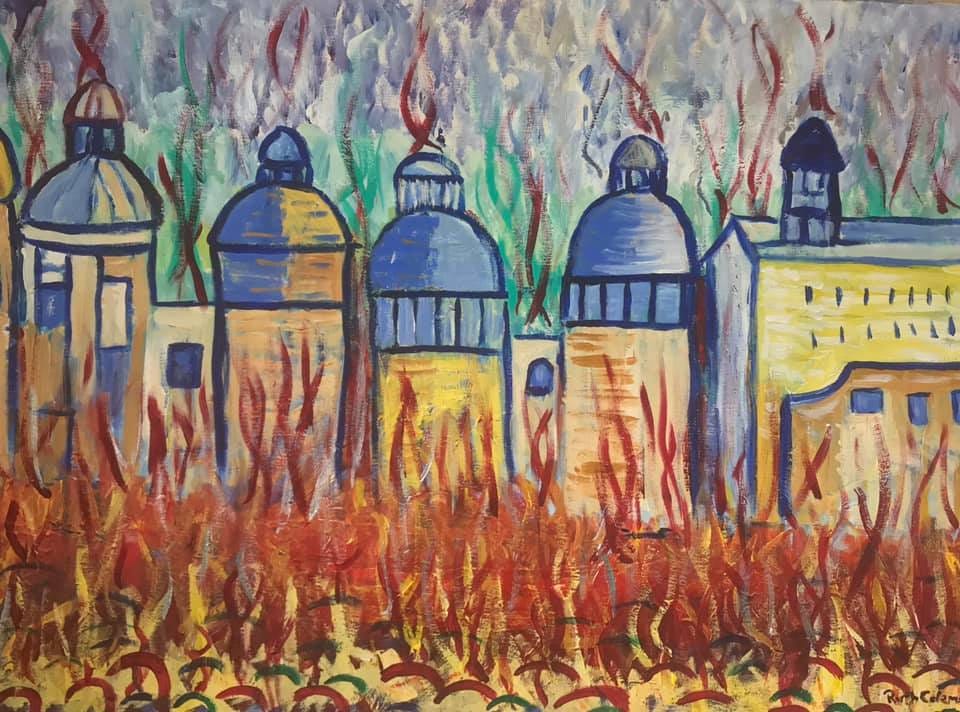
Cover image: ‘Pentecost’ by Ruth Jarvis Coleman (1956-2019)